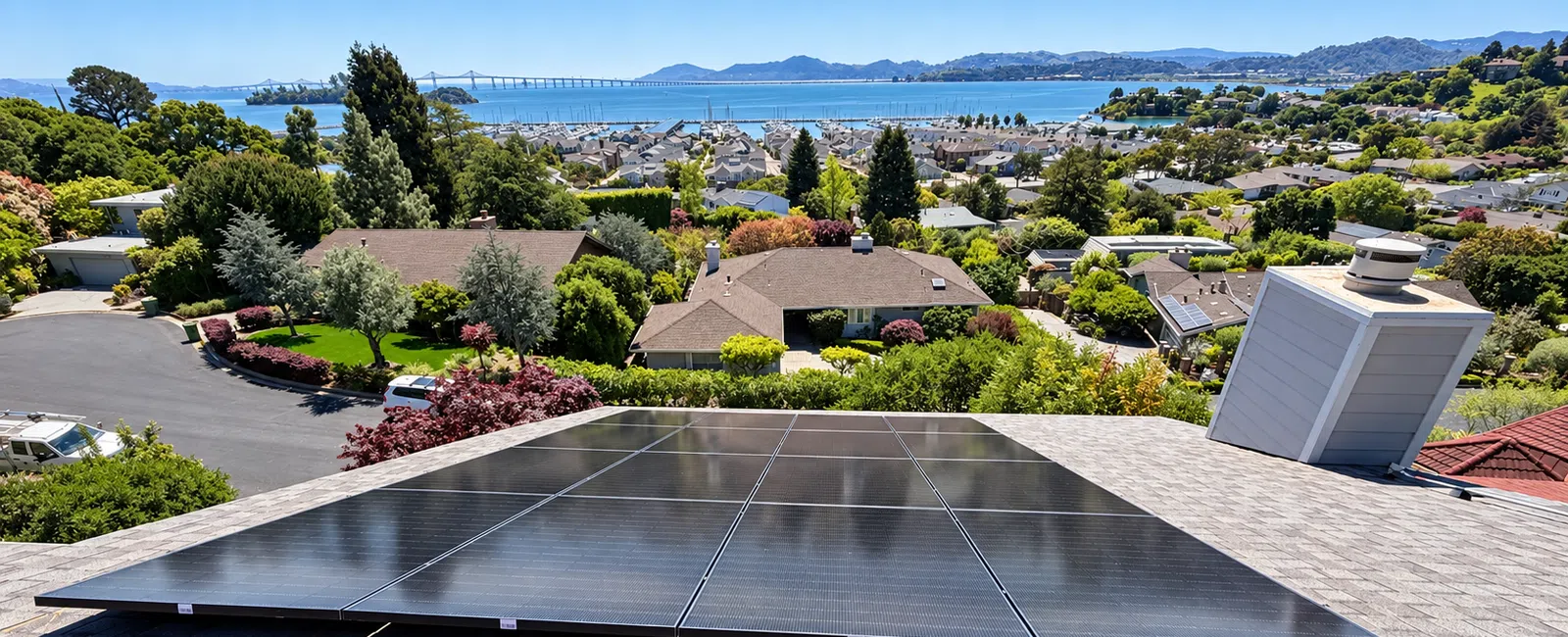
Most people go solar for the savings, and that's a perfectly good reason. But a home solar system offers a second return that's easy to overlook, and it's the one that keeps paying long after the financial math has settled. Every kilowatt-hour your roof makes is a kilowatt-hour that didn't have to come from somewhere else.
Multiply that by decades, then by thousands of homes across Marin, Sonoma, and Napa, and it adds up to something real.
What your roof does every day
A solar panel turns sunlight into electricity without burning anything. No fuel, no emissions while it runs, no moving parts, and no noise. It simply sits there and works.
That matters because the electricity a home doesn't generate has to be produced somewhere, and a meaningful share of grid power still comes from burning fossil fuels. When your panels cover your daytime use, that's demand the grid doesn't have to meet. Your home goes from being purely a consumer of energy to producing a good portion of what it needs.
Over the life of a system, that adds up far more than most homeowners picture. Panels built to produce for 25 to 30 years, as we cover in how long solar panels last, spend decades quietly displacing electricity that would otherwise be generated elsewhere.
Solar pays back its own footprint
A fair question people ask is whether it takes more energy to build a solar panel than the panel produces. It doesn't, and it isn't close.
Manufacturing panels does take energy, like manufacturing anything does. But a panel generates far more energy over its working life than went into making it, and it typically pays back that upfront energy within the first few years of producing. Everything after that is a net gain, year after year, for decades.
That's the part worth holding onto. A solar system isn't environmentally neutral. It runs a long surplus.
What happens at the end
The environmental case holds up at the other end of a system's life too. Solar panels are made largely of glass, aluminum, and silicon, all materials that can be recovered and reused, and panels that come off a roof in good shape can often be reused rather than recycled at all. Our post on whether solar panels can be recycled covers how that works.
So the full picture is a clean one from start to finish: an energy payback in the first few years, decades of clean production, and recoverable materials at the end. Few things a homeowner can add to a property hold up that well across their whole lifespan, and it's one of the quieter reasons solar has earned the place it has.
Why it matters here
The North Bay has never needed much convincing. Marin, Sonoma, and Napa are full of people who care about the land they live on, and many of the region's wineries, ranches, schools, and community organizations have gone solar for exactly that reason alongside the economics.
There's a practical local angle too. Electricity demand in California keeps climbing, driven by data centers, by more homes running on electricity instead of natural gas, and by electric vehicles. Every home that generates its own power takes a little pressure off that system. Solar on a North Bay roof isn't just good for that household. It's a small contribution to a grid that's being asked to do more every year.
Electrification makes it go further
A home system quietly multiplies its impact as a household electrifies. As more of a household runs on electricity rather than gas, the power source behind it matters more. An electric vehicle charged from your own solar is a very different thing from one charged entirely off the grid.
That's the compounding effect. The more of your home's energy you move to electricity, the more your panels are doing, because they're supplying a growing share of how you live. Add battery storage, and you extend your own clean power into the evening rather than pulling from the grid at the hours it's most strained.
Clean power that also makes sense
The nice thing about home solar is that you don't have to choose between doing right by the environment and doing right by your household budget. The same system that lowers your electricity costs also cuts your home's reliance on fossil-fueled power. Those goals point in the same direction, which isn't always true of environmental choices.
That's part of why solar has stuck around and grown for so long. It's a practical decision that happens to be a good one for the planet, rather than a sacrifice you make on principle.
Local, employee-owned, and in it for the long run
We've been putting clean energy on North Bay roofs since 1984, which means we've watched this industry grow from a niche idea into something ordinary. We're 100% employee-owned; we've installed more than 9,000 solar systems across Marin, Sonoma, and Napa, and we're licensed as a General Contractor (B) and Electrical Contractor (C-10). We were also one of the first companies in California to obtain the state's C-46 solar license.
We live here too, which is a big part of why this work matters to us. Every system we install is a little more clean energy in the place we call home.
Ready to put your roof to work? Contact SolarCraft or call Sonoma/Napa 707.778.0568 or Marin 415.382.7717.