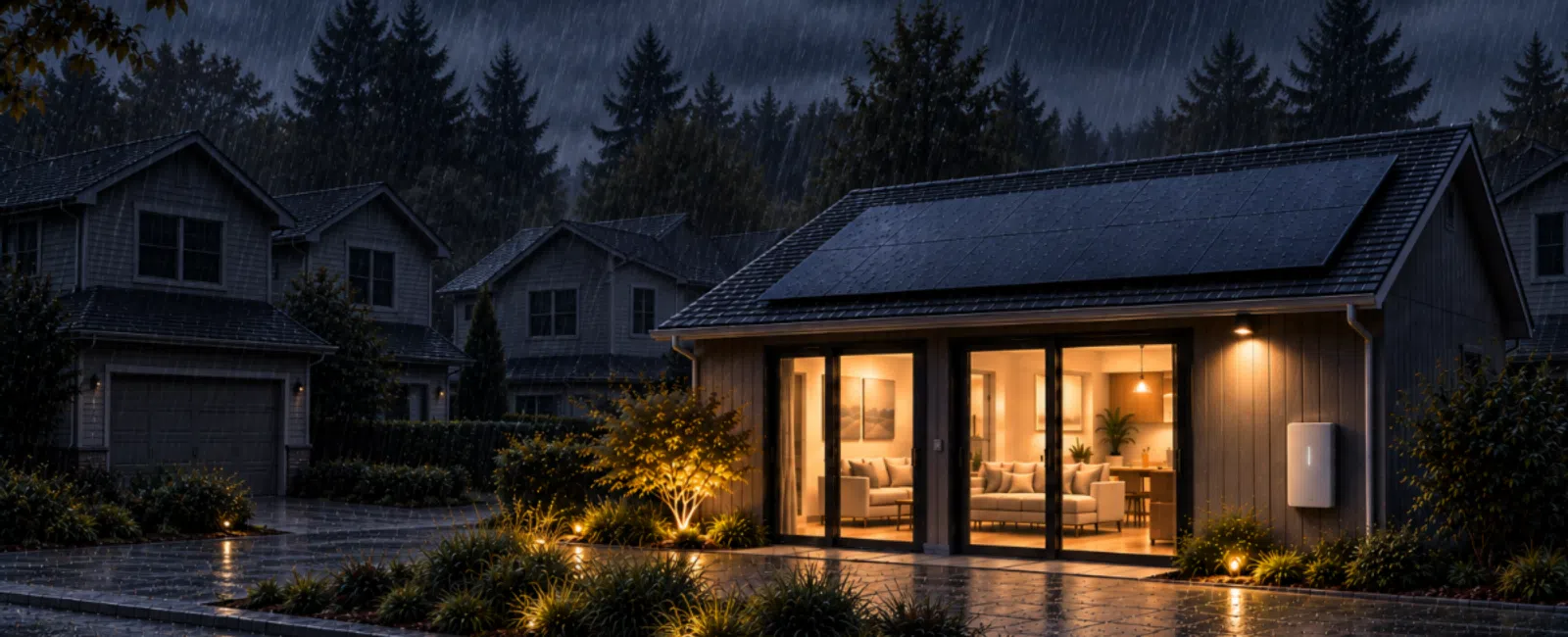
California is heading into what forecasters expect to be a strong El Niño winter. NOAA's outlook points to one of the most powerful El Niño events in decades, and for California that typically means a wetter, stormier season, with the heaviest stretch usually running from December through March. Big storms bring wind, saturated ground, and falling trees, and those are exactly the conditions that knock out power.
If you've been thinking about backup power, this is the time to act. Not during the first outage, and not after the first big storm, but now, while there's still time to install a system before the season arrives.
Why now matters
A home battery isn't something you pick up on the way home from the store. A properly installed system is designed for your home, permitted by your local building department, installed by a licensed crew, and approved by PG&E before it can switch on. Each step takes time, and some depend on other people's schedules.
That's the real reason to start now. Homeowners who wait until storms hit often end up in a long line, along with everyone else who had the same idea after the lights went out. Getting your project moving this fall gives you the best chance of having your battery ready before winter's heaviest weather rolls in. Our post on what to expect when you go solar walks through each step.
Two ways to keep the lights on
For backup power, most homeowners weigh two options: a generator or a home battery. Both can keep your home running when the grid goes down. They work very differently.
The generator
A standby or portable generator runs on fuel, usually natural gas, propane, or gasoline, and kicks in to power your home during an outage. Generators have been around a long time, and they can power a home through extended outages as long as the fuel lasts.
The tradeoffs are worth knowing, though. A generator does nothing for you the rest of the year. It sits idle, waiting for an outage, while still needing regular maintenance and test runs to make sure it starts when you need it. It needs fuel on hand, which can be hard to get during a widespread outage. It's also loud, produces exhaust, and must be placed carefully away from windows and doors.
The home battery
A home battery paired with solar takes a different approach. It stores the power your panels make during the day, and when the grid goes down, it takes over automatically. There's no switch to flip and no fuel to find. Your lights, refrigerator, internet, and other key circuits keep running, quietly, with no exhaust.
What makes it especially well suited to a long, stormy winter: your battery refills from your solar panels. Even on cloudy winter days, your panels keep producing, and that power goes back into the battery. A generator burns through its fuel supply. A solar battery keeps topping itself back up.
A battery works every day, not just during outages
This is the biggest difference, and it's why so many homeowners choose a battery over a generator. A generator is an insurance policy that only pays out when the power fails. A battery earns its keep every single day.
When the grid is up, your battery stores your daytime solar and lets your home run on it through the evening, when PG&E charges the most for electricity. That means lower electricity bills year-round, not just protection during the occasional outage. When storm season arrives, that same battery shifts into backup mode. You're not paying for a machine that sits idle for eleven months a year. You're investing in something that saves you money year-round and protects you when it counts. Our post on how battery storage powers your evenings and outages goes deeper on both jobs.
Getting your battery ready for winter
If you already have a battery, a little preparation goes a long way before the storm season. The simplest step is raising your backup reserve, the share of charge your battery holds back for an outage. In winter, shorter days mean less sunlight to refill the battery, and storms are more likely, so many homeowners hold more in reserve this time of year. It's a quick change in your battery's app, and our post on home battery settings and backup reserve explains how to think about it.
It's also a good time to confirm which circuits your battery backs up, check that your monitoring app is connected, and make sure your household knows what to expect when the grid goes down.
How much backup do you need?
The right amount depends on what you want to keep running and for how long. Covering the refrigerator, lights, internet, and a few outlets takes less capacity than running most of the home, and how your solar recharges the battery each day also matters. We size every battery system around your home's usage and your priorities, so you're protected for what matters most.
Start before the storms do
A strong El Niño winter is a good reason to stop putting off backup power. The forecast gives you something most outages don't: a heads-up. The homeowners who use that window to get a battery in place are the ones who'll ride out this winter's storms with the lights on, while still saving on their electricity bills every other day of the year.
We've designed and installed solar and battery systems across Marin, Sonoma, and Napa since 1984. We're 100% employee-owned; we've installed more than 9,000 systems, and we're licensed as a General Contractor (B) and Electrical Contractor (C-10). We were also one of the first companies in California to obtain the state's C-46 solar license. We handle design, permitting, PG&E approval, and installation with our own crews, so when you're ready, we can get started.
Don't wait for the first outage. Contact SolarCraft or call Sonoma/Napa 707.778.0568 or Marin 415.382.7717.