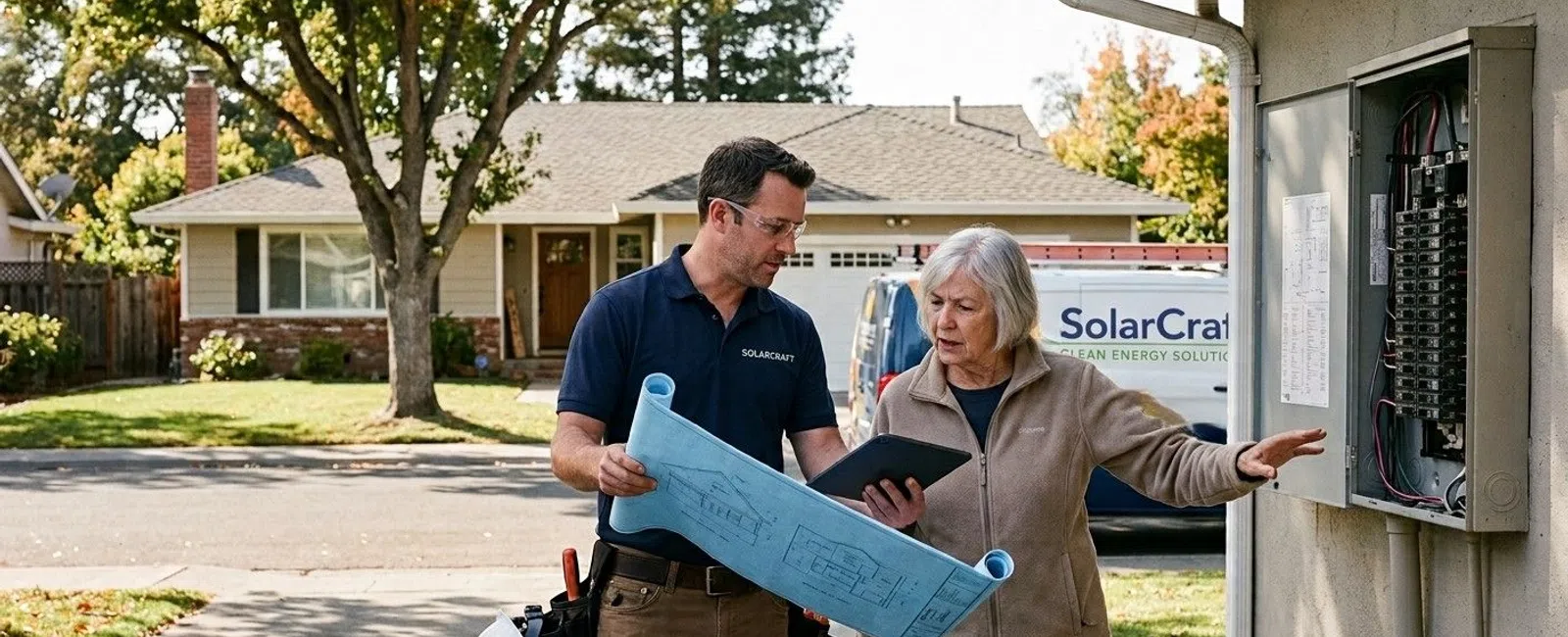
If you're considering solar and battery storage, you might be wondering whether you'll need to upgrade your electrical panel. The good news is that many homes don't. If yours does, we'll identify it early and factor it into your project from the beginning.
What your main panel does
Your main electrical panel, sometimes called the service panel or breaker box, is where power enters your home and gets distributed to every circuit. It's usually a gray metal box in your garage, on an outside wall, or in a utility closet. Inside are the breakers that protect each circuit, along with a main breaker that sets the total amount of power the panel can safely handle.
That total is the key number. Panels are rated by capacity, measured in amps, and that rating determines how much electrical load the panel can carry. Many homes have panels rated at 100, 125, or 200 amps, depending on when they were built and what's been updated since.
Why solar and a battery can affect your panel
Adding solar and a battery means connecting new power sources to your panel. Electrical code sets limits on how much power can safely feed into a panel based on its rating and the size of its main breaker. If a home's panel is on the smaller side, or already near its limit, adding a solar and battery system may require a larger panel.
- A few situations make an upgrade more likely:
- An older or smaller panel. Homes with lower-amp panels, or panels that are decades old, have less flexibility.
- A panel that's already full. If every breaker slot is in use, there may not be space to add the circuits a new system needs.
Bigger loads on the way. If you're planning an EV charger, an induction range, or other electric upgrades alongside solar and a battery, your home's total electrical demand goes up, and your panel needs to handle it.
Often, an upgrade isn't needed
Plenty of homes go solar and add a battery without touching their panel at all. Many homes already have a panel with enough capacity, and design approaches can avoid an upgrade in some cases, such as how the system connects to your panel or how battery backup circuits are arranged.
The right answer depends entirely on your home, which is why we look at it closely before recommending anything.
How we check during the site visit
Your panel is one of the first things we look at when we visit your home. We check its amp rating, the main breaker size, available space, overall condition, and current load. We also talk with you about what's ahead, whether that's an electric car, a home addition, or anything else that will add electrical demand down the road.
From there, we design your system around what your panel can handle. If it has room, great. If an upgrade makes sense, we tell you up front, explain why, and build it into your proposal, so there are no surprises halfway through the project. Our post on what to expect when you go solar walks through how the site visit fits into the bigger process.
When an upgrade is needed, we take care of it
If your home needs a new panel, we handle it as part of your project. We're licensed as an Electrical Contractor (C-10), so the electrical side of your system, panel work included, is done by qualified, licensed professionals rather than passed off to someone else. The upgrade gets permitted and inspected along with the rest of your system, and PG&E is involved where your service connection is affected.
There's a real upside, too. A new panel brings an older home up to modern capacity, which makes room for the electric upgrades many households are planning anyway. If an EV, a new kitchen, or other electrical work is in your future, a panel sized for it now means you won't have to revisit it later.
Planning ahead for the future
If you're building or doing a major renovation, it's an ideal time to think about your panel. We cover that in our post on building a new home with solar, where planning for solar, storage, and future loads from day one makes everything simpler.
For existing homes, the best approach is simply to bring it up early. Let us know what electrical changes you're considering over the next several years, and we'll design a system and recommend a panel setup that fits not just how you use power today, but how you'll use it in the years ahead.
A clear answer for your home
Whether your panel is ready as-is or needs an upgrade, you'll know before we install anything. We design each solar system and battery setup around your home's actual electrical service, so the whole system works safely and reliably for decades.
We've been doing this across Marin, Sonoma, and Napa since 1984. We're 100% employee-owned; we've installed more than 9,000 systems, and we're licensed as a General Contractor (B) and Electrical Contractor (C-10). We were also one of the first companies in California to obtain the state's C-46 solar license.
Wondering whether your panel is ready for solar and a battery? Contact SolarCraft or call Sonoma/Napa 707.778.0568 or Marin 415.382.7717.